
The C-Corporation: When It's the Right Trade-off
A practical guide to C-Corps for founders: why VC-backed companies are almost always Delaware C-Corps, how double taxation actually works, the Section 1202 / QSBS perk that gives founders up to $10M tax-free, when to choose Delaware vs. your home state, and when a C-Corp is the wrong choice.
14 min readPublished
If you're not raising venture capital and you're not planning a $10M+ exit in the next 5 years, you probably shouldn't form a C-Corp. If you are, it's not even close: you should. The decision is rarely subtle.
This guide is for founders standing on the edge of "do I need a C-Corp?" The honest answer for most readers is no. The honest answer for the small subset of readers building venture-track companies is yes, and here's how to do it right. We'll cover what a C-Corp actually is, how double taxation works (and when it's not as bad as it sounds), the Section 1202 / QSBS perk that's the real reason VC-backed founders form C-Corps, why Delaware became the standard, and when forming a C-Corp is just an expensive aesthetic choice.
This is a deep-dive in the Choosing a Business Entity cluster.
At a glance
- A C-Corp is the right entity for venture-backed startups and almost nobody else. Most small businesses lose more to double taxation than they gain in any other dimension
- The two real reasons to form a C-Corp: you're raising priced-equity venture capital (investors require it), or you're planning a Section 1202 / QSBS exit (up to $10M of gain tax-free if held 5+ years)
- Double taxation only matters when you distribute profit. If you reinvest everything in the business, only the 21% corporate tax applies. Most founders take W-2 salaries instead of dividends, partly to avoid this
- Delaware is the default for VC-backed companies because investors expect it, the case law is settled, and the legal mechanics of preferred stock and stock options work seamlessly
- The biggest C-Corp mistakes: forming in Delaware when you don't need to, missing the 83(b) election deadline, not tracking QSBS holding period, and dissolving the corp in a way that triggers double taxation on liquidation
What a C-Corp actually is
A C-Corporation is a separate legal and taxable entity. Unlike an LLC (which is a state legal entity but is taxed however you elect), a C-Corp is structurally different from its owners in both the legal and tax sense. The corporation:
- Holds property in its own name
- Signs contracts as itself
- Pays taxes on its own profit (Form 1120)
- Issues stock to shareholders
- Is governed by a board of directors elected by shareholders
- Has officers (CEO, CFO, etc.) appointed by the board
Owners of a C-Corp are called shareholders. Shareholders elect the board of directors. The board appoints officers (typically including a CEO who runs day-to-day operations). For a one-founder C-Corp, all three roles are usually the same person, but the legal structure exists, and certain corporate formalities (annual meetings, written resolutions for major decisions) are required to maintain the liability shield.
The "C" in C-Corp comes from Subchapter C of the Internal Revenue Code, which is the default federal tax treatment for corporations. The "S" in S-Corp comes from Subchapter S, which is an alternative tax election that some corporations can make.
How double taxation actually works
Double taxation is the most-cited downside of C-Corps, and it's both real and often overstated.
The math
A C-Corp pays a flat 21% federal corporate income tax on its net profit (Form 1120). After-tax profit can either be:
- Reinvested in the business (no second tax until distributed)
- Distributed to shareholders as dividends (taxed again on the shareholder's return)
When distributed, dividends are usually taxed at qualified dividend rates (0%, 15%, or 20% federal depending on the shareholder's bracket), plus state tax. Ordinary income tax applies if the dividend doesn't meet the qualified dividend rules (rare for normal C-Corp distributions to founders).
The combined effective tax rate on distributed profit:
| Action | Rate | Effect on $100 of corporate profit |
|---|---|---|
| Corporation earns $100 | (none yet) | $100 |
| Corporation pays 21% federal income tax | 21% | $79 left |
| Shareholder receives $79 dividend, pays 15% qualified dividend tax | 15% × $79 = $11.85 | $67.15 left |
| Combined effective tax | ~33% | $67.15 net to founder |
For a pass-through entity, the same $100 of profit is taxed once on the owner's individual return (federal income tax + SE tax, plus state). At a 24% federal income tax bracket plus 14.13% effective SE tax (capped at the SS wage base), the total is roughly 38% on early dollars and lower at higher incomes.
So the C-Corp + dividend route can actually be slightly better than pass-through at very high incomes (above the SS wage base), but worse at moderate incomes. The real question is what you do with the after-corporate-tax profit.
When double taxation doesn't matter much
If the C-Corp retains and reinvests profit (the typical pattern for VC-backed startups burning through funding), only the 21% corporate tax applies. There is no second-layer tax until profit is distributed, and most growth-stage startups never distribute dividends to founders. They distribute "profit" through the eventual exit (sale of stock), which is taxed at capital gains rates (typically 15% to 20%, or 0% under Section 1202 if QSBS qualifies).
If the C-Corp pays founders W-2 wages instead of dividends, the wages are deductible by the corporation (lowering corporate tax) and taxed once at the shareholder's individual rate. This is structurally similar to S-Corp salary mechanics and a standard pattern for owner-operated C-Corps.
The "double taxation problem" is most acute for established, profitable, owner-operated businesses that want to distribute cash to owners. For those businesses, an LLC or S-Corp election is structurally cleaner.
The real reason VC-backed founders form C-Corps: Section 1202 / QSBS
The under-appreciated upside of forming a C-Corp is Qualified Small Business Stock (QSBS) treatment under Section 1202 of the Internal Revenue Code. This is the rule that makes C-Corp formation worth the double-taxation overhead for venture-track founders.
The basic rule
If you (a non-corporate shareholder) hold qualifying C-Corp stock for at least 5 years, you can exclude up to the greater of:
- $10 million of gain on the sale of that stock, or
- 10× your basis (what you originally paid for the stock)
This exclusion is from federal income tax. State treatment varies (most states conform; California does not).
For a founder who started a company with a $50,000 founder investment and sold their stock for $5M after 5 years, all $4.95M of gain ($5M sale minus $50K basis) is excluded under the $10M cap. Federal tax: $0.
Eligibility tests
QSBS treatment requires all of:
- C-Corp: the company must be a domestic C-Corporation when the stock was acquired and substantially throughout the holding period
- Original issue: the stock must have been acquired directly from the corporation (typically at founding or in a financing round), not from a previous shareholder
- Gross assets test: the corporation must have had less than $50 million in gross assets at the time the stock was issued (and immediately after issuance)
- Active business test: at least 80% of the corporation's assets must be used in a "qualified trade or business" (most things except finance, hospitality, certain professional services like law/medicine/accounting, and farming)
- Holding period: 5 years from acquisition to sale
Stock issued after September 27, 2010 qualifies for the 100% exclusion (the rule was earlier 50%, then 75%, before being permanent at 100% in PATH Act 2015).
Why this is huge for founders
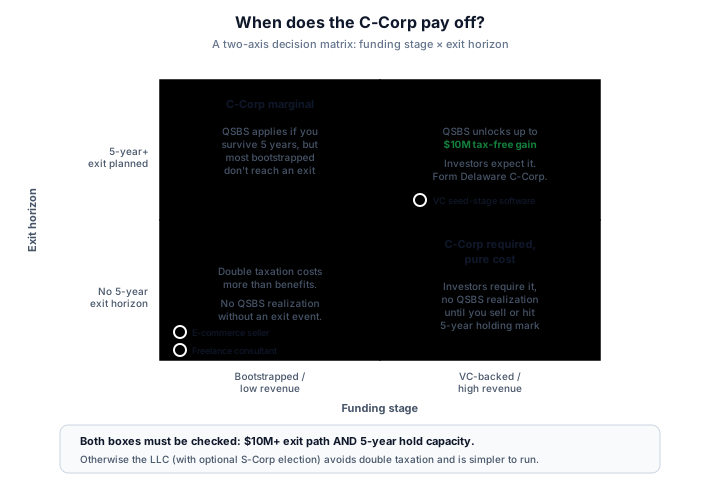
For a founder building a company that exits for $10M+ after 5 years, QSBS can save $2 million to $3 million in federal tax (the 23.8% federal cap gains + NIIT rate × the excluded gain). That's larger than virtually any other tax savings opportunity in the IRS code.
Critically, only C-Corps qualify for QSBS. LLCs, S-Corps, and partnerships don't. This single rule explains why most VC-backed founders form C-Corps even when the double-taxation math looks worse.
Why Delaware is the standard
For VC-backed startups, the conventional wisdom is "form a Delaware C-Corp." This is not a tax decision (Delaware has no friendlier corporate income tax rate than other states); it's a legal infrastructure decision.
The case for Delaware
-
Investor expectation. Every VC fund's standard term sheet, certificate of incorporation, voting agreement, and stockholder agreement is written for Delaware corporate law. Forming elsewhere means rewriting documents and adding legal complexity to every financing.
-
Court of Chancery. Delaware has a specialized court that handles corporate disputes (M&A litigation, fiduciary duty claims, shareholder oppression). It's the most predictable forum for corporate law in the country, with decades of detailed case law.
-
Modern statute. The Delaware General Corporation Law is updated regularly to reflect modern financing practices (preferred stock structures, SAFEs, convertible notes, anti-dilution). Other states' statutes lag.
-
Privacy. Delaware doesn't require shareholder names in public formation filings (unlike, say, California or New York).
-
Familiar legal infrastructure. Almost every major US law firm has a deep Delaware corporate practice. Specialized VC counsel can move faster on Delaware deals.
The case against Delaware (for non-VC-track companies)
If you form a Delaware C-Corp and operate in California, you owe:
- Delaware franchise tax (~$300/year minimum, can be much higher for authorized share counts)
- Delaware registered agent service (~$100-$300/year)
- California foreign qualification (you "do business" in California, so you must register as a foreign corporation)
- California's $800 minimum franchise tax (regardless of profit)
- California corporate income tax on California-source income
You're paying both states' fees with no offsetting benefit. The pure-Delaware play almost always loses for operating businesses that aren't raising VC.
When to form in your home state instead
If you're not raising venture capital, form in your home state. The legal protection is the same. The case law is settled enough for typical small business needs. The annual cost is lower. The only "downside" is that you'll need to convert if you later raise priced-equity venture capital, which is a real but manageable cost ($5,000-$15,000 in legal fees and a few weeks of timing).
For most founders, "form in Delaware now in case I raise VC later" is over-engineering. The conversion later is cheaper than the years of dual-state overhead.
Founder taxation in a C-Corp
For owner-operated C-Corps, founders typically receive money from the corporation in three forms:
1. W-2 wages
The most common pattern. The corporation pays the founder a salary (subject to FICA), deducts the wage as a business expense (lowering corporate income tax), and the founder reports the W-2 income on their personal return. Effective tax: same as any W-2 employee at that income level (income tax + employee FICA), with no second-layer corporate tax on the wage portion.
This is structurally similar to S-Corp salary mechanics. The key difference: in a C-Corp, the corporation pays the employer portion of FICA out of corporate funds, deducting the full FICA cost.
2. Dividends
Distributions of after-tax corporate profit. Subject to qualified dividend tax (typically 15-20%). This is where double taxation hits: 21% corporate tax + 15-20% dividend tax.
For owner-operated C-Corps, dividends are usually a small share of total founder compensation. Most founders take W-2 wages instead.
3. Stock sale (the QSBS opportunity)
If the founder sells stock (typically at exit), the gain is taxed at long-term capital gains rates (15-20% federal, plus 3.8% NIIT). If the stock qualifies for Section 1202 / QSBS treatment, the federal gain (up to $10M or 10× basis) is excluded.
This is the most important wealth-creation event for venture-track founders, and the reason QSBS is the centerpiece of C-Corp planning.
The 83(b) election (don't miss this)
If you're a founder receiving stock in a C-Corp subject to vesting (a standard arrangement), you must file an 83(b) election with the IRS within 30 days of receiving the stock to be taxed at issuance (when the stock is worth nothing) rather than as it vests (when the stock has appreciated).
Missing the 30-day deadline is one of the most expensive mistakes a founder can make. If you don't file, you'll be taxed on the spread between the strike price and the fair market value as each tranche vests, which can mean six- or seven-figure tax bills on stock you can't sell yet.
The 83(b) election is a one-page form. File it. Keep proof. This is the kind of advice every founder needs to hear five times.
When NOT to form a C-Corp
For the readers most likely to find this guide via search, the answer is "not now and probably not ever." Here's the negative case more explicitly:
| Your situation | Why C-Corp is wrong |
|---|---|
| Freelance consulting, design, software contracting | Pass-through (LLC or sole prop) is simpler and tax-efficient |
| E-commerce, retail, restaurant, services | LLC + S-Corp election once profit > $100K is the right structure |
| Real estate investing, rental property | Pass-through avoids double taxation on appreciation; S-Corp has issues with passive losses |
| Lifestyle business with no exit plans | C-Corp is pure cost: filing fees, double tax on distributions, no QSBS realization |
| Bootstrapped business with founders taking distributions | LLC or S-Corp election; C-Corp dividends are taxed twice |
| Family-owned business passed to next generation | LLC is more flexible; C-Corp creates additional complexity at gift/estate time |
The C-Corp is a precision tool for one specific use case: venture-track companies. Using it for anything else is using a chainsaw to butter toast.
Worked example: a seed-stage software startup
Maya is forming a software startup. She has a co-founder (Jay, 50% equity), $200,000 in friends-and-family money committed, a clear product roadmap, and a goal of raising a Series A in 18 months. They expect $0 of revenue in year 1.
Why C-Corp is the right answer
- They're raising priced-equity capital from investors who will require Delaware C-Corp formation
- They want QSBS eligibility for their founder stock (5-year clock starts at issuance)
- They plan to issue stock options to early employees (ISOs and NSOs are C-Corp mechanisms)
- They're not taking distributions; double taxation is irrelevant pre-revenue
Formation steps
- File certificate of incorporation in Delaware (~$90 + registered agent ~$200/year)
- Adopt bylaws and elect a board (Maya, Jay, and their first investor at Series A)
- Issue founder stock at a low strike price (to maximize QSBS upside) with vesting (typically 4 years with a 1-year cliff)
- File 83(b) elections within 30 days of stock issuance for both founders
- Set up a stock plan (typically 10-15% reserved for employees) with ISO and NSO templates
- Foreign qualify in their home state if operating outside Delaware
- Open corporate bank account (separate from any founder personal accounts)
- Draft a stockholder agreement governing transfers, drag-along rights, ROFR, vesting acceleration on change of control
Costs
- Legal fees for full setup: $3,000-$8,000 (varies by firm; some offer "founder packages")
- Annual Delaware franchise tax: $300-$1,500+ (depends on authorized share count and assumed-par calculation)
- Registered agent: ~$200/year
- Foreign qualification fees in operating state: ~$100-$500 first year
- Annual filings: ~$0-$200 in most home states
For a venture-track startup with $200K committed, this is a rounding error compared to the QSBS upside. For a bootstrapped consulting business, this would be ridiculous overhead.
Common mistakes
-
Forming in Delaware when you don't need to. The dual-state overhead is real and adds up over years. If you're not raising priced-equity venture capital within 12 months, your home state is fine.
-
Missing the 83(b) deadline. 30 days from stock issuance, no extensions. This is the most expensive deadline in startup tax. Every founder receiving stock should file 83(b); every advisor reminds them; some still forget.
-
Not tracking QSBS holding period. The 5-year clock starts at stock issuance, not at company formation. If you join 6 months in and receive stock then, your clock is 6 months later. Track this carefully; selling 1 day too early loses the entire QSBS exclusion on those shares.
-
Issuing too few authorized shares. "We'll just authorize 1,000 shares" sounds simple but creates problems at financing time when you need to issue preferred stock and grant options. Standard practice: 10,000,000 authorized common shares at incorporation.
-
No founder vesting. Co-founders without vesting can quit on day 31 with 50% of the company. Standard: 4-year vesting with 1-year cliff for all founders, regardless of role.
-
Mixing personal and corporate funds. Same as LLCs: keep separate accounts, don't use the corporate card for personal expenses. Plus the corporate formalities (resolutions for major decisions, written shareholder consents).
-
Dissolving a successful C-Corp without planning. Liquidating a C-Corp with appreciated assets triggers corporate-level gain on the appreciation plus shareholder-level gain on the distributed cash. For successful businesses, dissolution can cost more than the C-Corp ever saved.
Read related guides in the cluster
- Choosing a Business Entity: the pillar that explains where the C-Corp fits in the broader entity landscape
- The LLC: How It Works and When to Use It: the alternative most non-VC businesses should choose
- The S-Corp Election: How and When It Saves Money: the mid-point between LLC default and C-Corp; appropriate for established profitable businesses not on a venture track
- Owner Draws and Contributions: how owner equity flows through different entity types
Key takeaway
The C-Corp is the right choice for one specific situation and the wrong choice for almost everything else. The decision is rarely subtle:
- Form a C-Corp if you're raising priced-equity venture capital (or planning to within 12 months) AND you have a credible path to a $10M+ exit AND you can hold founder stock for 5+ years for QSBS treatment
- Don't form a C-Corp if you're a freelancer, consultant, lifestyle business owner, real estate operator, e-commerce seller, or anyone planning to take distributions of profit. The double taxation costs more than the entity's benefits
Three habits make a C-Corp work when it's the right choice:
- File the 83(b) election within 30 days of receiving founder stock. No exceptions, no excuses. Every founder, every advisor, every employee receiving restricted stock.
- Track the QSBS holding period from stock issuance, and don't sell early. Selling on day 1,824 (one day shy of 5 years) loses the entire exclusion.
- Plan the exit, not just the formation. Dissolution of a profitable C-Corp can cost more than the entity ever saved if you don't structure the exit cleanly.
If you're standing at the formation decision and the C-Corp is the right answer, hire a real startup lawyer. The $3,000-$8,000 in formation legal fees pays for itself the first time something complicated happens, which is usually within 6 months.
References
- IRS: C Corporations: federal corporate income tax overview
- IRC §1202: Partial exclusion for gain from certain small business stock: the QSBS statute
- IRS: Election under §83(b): 83(b) election form and instructions
- Delaware Division of Corporations: formation, franchise tax, and registered agent rules for the standard incorporation state
- SEC: Smaller Reporting Company: securities-law context for venture-stage companies
Disclaimer
C-Corp formation, securities issuance, QSBS qualification, and corporate exit transactions involve federal tax, state tax, and securities law considerations that vary significantly by company stage, structure, and jurisdiction. Section 1202 / QSBS rules have specific eligibility tests and a 5-year holding period that must be tracked precisely. Delaware incorporation has unique franchise tax mechanics, and foreign qualification rules vary by operating state. This guide explains the framework at a high level and is not legal, tax, or financial advice. Consult licensed corporate, tax, and securities counsel before forming, financing, or exiting a C-Corporation.
Try it in Sedna
See this in action in the app. Open in app