
The S-Corp Election: How and When It Saves Money
A practical guide to the S-Corp election: what it actually is (a tax election, not an entity), when the math works, the reasonable-salary problem, the California exception, and a worked example showing $7,000 to $10,000 in annual savings at typical small-business profit levels.
15 min readPublished
Once your business reliably profits more than $100,000 a year, the S-Corp election is the single biggest legal tax-saving lever available to you. It is also one of the most over-prescribed and most over-feared decisions in small-business tax. Online forums treat it like a magic spell. CPAs sometimes treat it like a tripwire.
The actual story: it's a tax election, not an entity. It saves real money in a specific income range. The savings plateau at high incomes. And it comes with a non-trivial compliance cost that determines when the math actually works.
This guide walks through what the election really is, the math at common income levels, the reasonable-salary problem (the only thing that can turn a clean win into an audit), the California exception, and a step-by-step worked example. By the end you will know whether the S-Corp election is right for you today, and what number you need to hit before revisiting it.
Want the number for your situation first? Try the S-Corp vs Sole Prop tax savings calculator: plug in your revenue, expenses, and a reasonable salary, and it shows your 2026 federal tax difference and break-even point. Then come back here for the context that makes the number trustworthy.
This is a deep-dive in the Choosing a Business Entity cluster. If you haven't read the pillar guide, start there. If you have, continue.
At a glance
- An S-Corp is not an entity, it's a federal tax election. An LLC or a corporation files Form 2553 to be taxed under Subchapter S. The legal entity stays the same; only the tax treatment changes
- The election lets owner-employees split their income between W-2 salary (subject to FICA) and distributions (not subject to FICA). The savings are roughly 14 cents per dollar of profit above your reasonable salary, capped at the Social Security wage base
- The math typically works above ~$100,000 of net profit in most states, and ~$130,000 to $150,000 in California. Below that, compliance costs ($1,500 to $3,000/year) usually exceed the FICA savings
- The savings plateau at high incomes (around $9,000 to $10,000 a year) because Social Security caps at the wage base ($176,100 in 2025) and reasonable salary obligations grow with the role
- The biggest risk is reasonable compensation. Setting salary too low to maximize distributions is the most common audit trigger for S-Corps. Use comp survey data and document the reasoning
What the S-Corp election actually is
Before the math, two corrections that fix most of the confusion online:
-
An S-Corp is a tax election, not an entity type. When someone says "I have an S-Corp," what they usually mean is "I have an LLC (or corporation) that has elected S-Corp tax treatment by filing Form 2553." The underlying state-level entity (the LLC, the corp) keeps its legal identity; only how the IRS taxes its income changes.
-
The election does not eliminate self-employment tax. It changes what income is subject to FICA. As an S-Corp owner-employee, you split your business income into two parts:
- W-2 salary: subject to the same 15.3% FICA (Social Security + Medicare) that any employee pays, split between you and the corporation
- Distributions (also called K-1 income): not subject to FICA or SE tax; you pay only ordinary income tax
The trick is that the IRS says the salary has to be reasonable for the role you do. You cannot pay yourself a $20,000 salary on a $300,000 profit and call the rest "distribution." That is the central tension of the S-Corp election, and the reason most of this guide is about the salary question.
The break-even math
The election only saves money if the FICA savings on the distribution portion exceed the compliance cost. Here are the savings at common income levels, assuming a defensible salary that scales with profit and a typical $2,000 annual compliance cost:
| Net business profit | Defensible salary | Distribution | Sole prop SE tax | S-Corp combined cost* | Annual savings |
|---|---|---|---|---|---|
| $80,000 | $50,000 | $30,000 | $11,304 | $9,650 | $1,654 |
| $100,000 | $60,000 | $40,000 | $14,130 | $11,180 | $2,950 |
| $150,000 | $80,000 | $70,000 | $21,195 | $14,240 | $6,955 |
| $200,000 | $100,000 | $100,000 | $27,192 | $17,300 | $9,892 |
| $300,000 | $130,000 | $170,000 | $30,564 | $21,890 | $8,674 |
| $400,000 | $150,000 | $250,000 | $34,074 | $24,950 | $9,124 |
* S-Corp combined cost = FICA on the W-2 salary (employer + employee halves, since the owner pays both economically) plus an assumed $2,000 in annual compliance overhead.
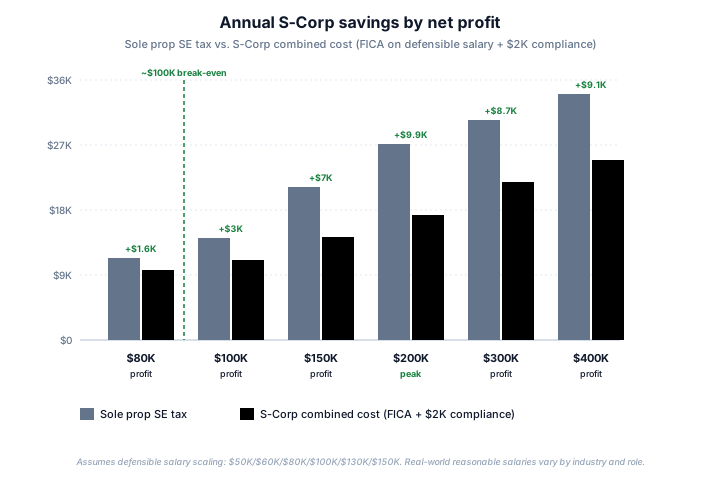
Three insights from this curve that most online S-Corp content misses:
-
The break-even is not a single number. It's a band from roughly $80,000 to $110,000 of profit where savings are smaller than compliance costs in many practical cases. Above $130,000 the math is clean.
-
Savings peak around $200,000 of profit. The combination of "reasonable salary scales with profit" and "Social Security only taxes the first $176,100 anyway" means the gap between sole prop SE tax and S-Corp combined cost is widest in the $200K-$250K range.
-
Savings plateau at high incomes. A founder netting $400K does not save 5x what a founder netting $80K saves. Both are bumping up against natural caps. The S-Corp election remains worthwhile at high incomes (it's $9K-$10K of free money), but it is not a percentage-of-profit lever.
The reasonable salary problem
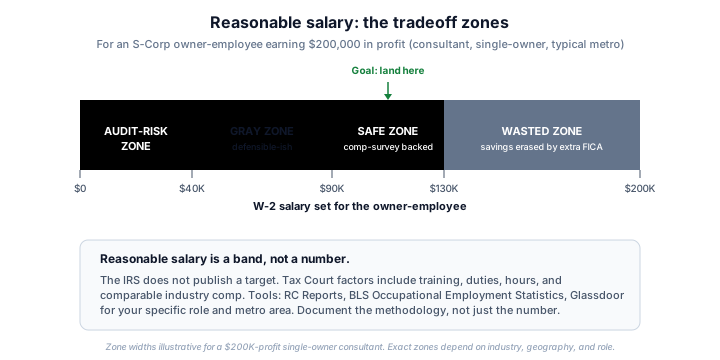
This is the question that decides whether your S-Corp savings are real or audit-bait. There is no IRS form that asks "what is your reasonable salary?" There is no safe harbor. Yet auditors and Tax Court cases have established a pretty clear set of factors.
What "reasonable" means
Reasonable compensation is what someone with your skills, experience, and role would earn as an employee at a comparable employer in your geographic area. The Tax Court factors (from cases like Watson v. Commissioner and Glass Blocks Unlimited v. Commissioner) include:
- Training and experience of the owner-employee
- Duties and responsibilities
- Time and effort devoted to the business
- Comparable salaries paid for similar services
- Compensation history
- Dividend history (an S-Corp paying $20K salary and $200K distributions is signaling something)
- Use of formula-based or arbitrary compensation
The practical implication: document the methodology you used. A defensible reasonable salary is one where, if audited, you can show the comp survey, the role description, and the math. An indefensible one is "I picked a number that minimized FICA."
Common rules of thumb (with caveats)
You'll see various heuristics online. Here are the common ones and what they actually mean:
- "Pay yourself 60% salary, 40% distribution." Outdated. The 60/40 rule was floated in old tax forum posts and has no IRS basis. The Tax Court has explicitly rejected formula-based approaches.
- "Pay yourself one-third salary, two-thirds distribution." Same problem, different formula. Still no IRS support.
- "Pay yourself a salary that matches industry comp surveys for your role." This is the actual standard. Tools like RC Reports, the BLS Occupational Employment Statistics, and Glassdoor for your specific role and metro area give you defensible numbers.
The salary in the table above (rising from $50K at $80K profit to $150K at $400K profit) follows roughly a comp-survey approach for a single-owner service-business consultant. Your defensible number depends on what you do, where you do it, and how many hours you put in. A $400K profit lifestyle business owner working 20 hours a week does not need to pay themselves the same salary as a $400K profit firm owner working 60 hours.
The compliance cost
The election only pays off if the savings clear the compliance cost. Here's what compliance actually involves:
| Item | Annual cost | Notes |
|---|---|---|
| Form 1120-S federal filing | $300-$800 | If you DIY with software like TaxAct Business; $800-$1,500 with a CPA |
| State S-Corp filing | $0-$500 | Varies by state. Some states have no separate S-Corp return |
| Payroll service (Gusto, ADP, OnPay) | $480-$960 | Required because you are now a W-2 employee. Usually $40-$80/month |
| W-2 + W-3 filings | included in payroll service | Year-end reporting for your salary |
| State unemployment insurance | $50-$500 | Mandatory in most states for any W-2 employee, including the owner |
| Optional CPA support | $0-$2,000 | Many small S-Corps use a CPA; some DIY |
| Typical total | $1,500-$3,000 | The middle of this range is the practical break-even baseline |
The compliance cost is roughly fixed regardless of profit, which is why the math doesn't work at low income levels. Going from $80K profit to $200K profit roughly doubles the FICA savings, but the compliance cost barely moves.
Filing the election: Form 2553
To elect S-Corp tax treatment, the entity files IRS Form 2553 (Election by a Small Business Corporation). The form is short (4 pages), free to file, and the IRS approval is typically automatic if the eligibility tests pass.
Eligibility (IRC §1361)
The entity must be:
- Domestic (US-formed)
- Have only allowable shareholders (US individuals, certain trusts, estates; not partnerships, corporations, or non-resident aliens)
- Have no more than 100 shareholders
- Have only one class of stock (different voting rights are okay; different economic rights are not)
- Not be an ineligible entity (insurance companies, banks, certain financial institutions)
Most LLCs and small corporations easily clear these tests. The "100 shareholders" test rarely matters for small businesses; the "no foreign owners" test is the most common deal-breaker.
Timing
For the election to take effect for the current tax year:
- For an existing entity: file Form 2553 by March 15 (two months and 15 days into the year for calendar-year filers)
- For a newly formed entity: file within 75 days of formation
Miss the deadline and the election applies to the following year, costing you a year of S-Corp benefits.
Late-election relief
If you missed the deadline, Rev. Proc. 2013-30 provides a late-election relief mechanism. You can file Form 2553 up to 3 years and 75 days late if:
- You had reasonable cause for missing the deadline
- You've consistently treated the entity as an S-Corp since the intended effective date
- You've filed all required tax returns consistent with the S-Corp treatment
The IRS has been generous with this in practice, but don't rely on it. File on time. The cost of a missed deadline is real ($7,000+ in foregone savings for a $150K-profit business).
The California exception
Most state-level rules are minor. California is the exception worth understanding before you elect.
California imposes a 1.5% S-Corp tax on the entity's net income (after deducting the W-2 salary), with an $800 minimum. This is on top of the regular California income tax that flows through to the owner.
Practical impact for a California-based S-Corp at $150K profit, $80K salary:
- S-Corp net income (after salary): $70,000
- California 1.5% S-Corp tax: $70,000 × 0.015 = $1,050 (above the $800 minimum)
- Federal savings before CA tax: $6,955
- Net California-adjusted savings: $5,905
Still positive at $150K, but the California tax pushes the practical break-even from ~$100K (federal) to roughly $130,000 to $150,000 of profit before the math reliably works. At lower profits in California, the federal savings can be entirely consumed by the state S-Corp tax plus compliance costs.
This is the only state-level callout that materially changes the decision. Other states (NY, TX, FL, WA, etc.) have small filing fees that don't move the needle. If you're in California and considering the election, factor the 1.5% explicitly.
Worked example: a $200K consultant
Sarah runs a single-owner marketing consulting LLC. In 2025 she nets $200,000 of profit (her clients pay $230,000 in fees, she has $30,000 in deductible expenses). She lives in Texas (no state S-Corp tax). She's wondering whether to elect S-Corp status for 2026.
Year 1 as a default LLC (sole-prop tax treatment)
- Net Schedule C profit: $200,000
- SE tax: $200,000 × 0.9235 × 15.3% = $27,192 (with Medicare portion above $176,100 wage base)
- Half-deduction reduces income tax base by $13,596
- Income tax (assume 24% effective): roughly $44,000
- Total federal tax: ~$71,000
Year 2 as an LLC with S-Corp election
Sarah works with her CPA to set a reasonable salary using RC Reports comp data: $100,000 (the median for marketing consultants in her metro area with 8+ years experience). The remaining $100K becomes a distribution.
- W-2 salary: $100,000
- FICA on salary (combined employer + employee, paid through corp + paycheck): $100,000 × 15.3% = $15,300
- Distribution: $100,000 (no FICA, no SE tax)
- Compliance: $2,000 (Gusto payroll + 1120-S filing + light CPA support)
- Income tax base: $100K salary + $100K distribution = $200K (same as before)
- Income tax: roughly $44,000 (essentially unchanged)
- Total federal tax: $15,300 + $44,000 + $2,000 = ~$61,300
The savings
| Sole prop (default) | S-Corp election | Difference | |
|---|---|---|---|
| FICA / SE tax | $27,192 | $15,300 | -$11,892 |
| Compliance cost | $0 | $2,000 | +$2,000 |
| Income tax | ~$44,000 | ~$44,000 | $0 |
| Total federal | ~$71,192 | ~$61,300 | -$9,892 |
Sarah saves roughly $9,900 a year by electing S-Corp status. Over 5 years that compounds to roughly $50,000 of additional take-home, plus whatever she invests it into.
The catch: she has to document her reasonable salary with the comp survey, run monthly payroll through Gusto, and file Form 1120-S every March 15 (separate from her personal 1040). For most consultants at this income level, the savings clearly justify the overhead.
When to revoke or revisit
The S-Corp election is not a one-way door. Common reasons to revoke:
-
Profit drops below the break-even. If your business shrinks to $60K of profit, the compliance cost may exceed the FICA savings. You can revoke the election by filing a written statement with the IRS and waiting until the start of the next tax year (or earlier with sufficient cause).
-
You're taking outside investment. S-Corps have ownership restrictions (no foreign owners, no corporate shareholders, single class of stock) that conflict with most VC term sheets. If you're raising priced-equity capital, you'll convert to a C-Corp first.
-
You're selling the business. S-Corps and C-Corps have different exit tax treatment. If you're considering Section 1202 / QSBS for a tax-free exit, you need to be a C-Corp (and have been one for the 5-year holding period).
-
You moved to California from elsewhere. The 1.5% CA S-Corp tax can flip the math from "obviously worth it" to "marginal."
If you revoke, there's a 5-year cool-down before you can elect S-Corp status again on the same entity (without IRS consent). So don't revoke on a whim.
Common mistakes
-
Setting the salary too low. The single most common audit trigger. "I run a $300K firm and pay myself $30K" is a red flag. Even without an audit, the IRS can challenge the salary years later and reclassify distributions as wages, with back FICA + interest + penalties.
-
Filing Form 2553 late and assuming it's automatic. The current-year election deadline is March 15 (or 75 days from formation for new entities). Late relief exists but isn't guaranteed. Calendar this annually.
-
Forgetting state S-Corp filings. Most states recognize the federal election automatically; some (like New York) require a separate state election. California adds the 1.5% tax. Check your state's rules.
-
Commingling distributions. Once you're an S-Corp, distributions need to be paid like distributions: with documentation, in proportion to ownership, after reasonable salary is paid. Random transfers from the business account to your personal account are not "distributions" until you treat them like distributions.
-
Forgetting payroll deadlines. As an owner-employee, you now have to make federal payroll tax deposits, file quarterly 941s, and issue yourself a W-2. Missing these triggers penalties that compound quickly. Use a payroll service.
-
Ignoring fringe benefit rules. S-Corp owner-employees lose access to certain fringe benefits available to C-Corp employees (the §125 cafeteria plan rules don't apply to >2% S-Corp shareholders the same way). Health insurance has special handling: included in W-2 wages but deductible above the line. Talk to your CPA about this if you have employer-provided benefits.
Read related guides in the cluster
- Choosing a Business Entity: the pillar guide that puts the S-Corp election in the broader context of which entity to form
- The LLC: How It Works and When to Use It: the typical "before" entity for an S-Corp election. Most S-Corps are LLCs that elected S status
- Self-Employment Tax: the tax the S-Corp election partially eliminates. Read this for the underlying mechanics
- Owner Draws and Contributions: how owner equity flows differ between sole-prop draws and S-Corp salary + distributions
- Accountable Plans: the right way for S-Corp owners to reimburse home office, mileage, and business-use-of-personal expenses
Key takeaway
The S-Corp election is the biggest legal tax-saving lever for established small businesses, and one of the most over-prescribed by online content for businesses that haven't earned it yet.
Three rules of thumb that keep the decision clean:
- Don't elect below ~$100,000 of net profit ($130K-$150K in California). The compliance costs eat the savings. There's no point.
- When you do elect, document your reasonable salary with comp survey data and revisit it annually. The single biggest risk to S-Corp savings is an indefensible salary.
- Don't expect linear savings as profit grows. The election yields about $9,000-$10,000 a year at peak (around $200K profit) and plateaus from there. It's a meaningful annual saving, not a percentage-of-revenue bonanza.
If your CPA can defend a salary, your profit clears the break-even, and you're not in the middle of a fundraise or imminent sale, the S-Corp election is one of the cleanest tax decisions in small business. File the form, run payroll, and pocket the savings.
References
- IRS Form 2553: Election by a Small Business Corporation: the form itself with line-by-line instructions
- IRC §1361: S corporation defined: the eligibility statute
- IRC §1366: Pass-through of items to shareholders: how S-Corp income is taxed at the shareholder level
- Rev. Proc. 2013-30: late-election relief for S-Corp and other entity classification elections
- IRS: S Corporation Compensation and Medical Insurance Issues: IRS guidance on reasonable comp and owner-employee health insurance
- California FTB: S Corporations: the 1.5% California S-Corp tax mechanics
- Watson v. Commissioner, 668 F.3d 1008 (8th Cir. 2012): the leading federal court case on S-Corp reasonable compensation
Disclaimer
The S-Corp election has tax, compliance, and audit implications that vary by income, industry, state, and personal circumstances. Reasonable compensation is a fact-specific determination that depends on your role, geography, comp survey data, and the IRS's evolving interpretation of Tax Court precedents. State-level rules, the federal compliance cost, the Social Security wage base, and the federal tax brackets change annually. This guide explains the mechanics at a high level and is not tax, legal, or financial advice. Consult a CPA licensed in your state before electing, revoking, or modifying your S-Corp treatment.
Try it in Sedna
See this in action in the app. Open in app