
The LLC: How It Works and When to Use It
A practical guide to the LLC: what it actually is at the state level, how single-member and multi-member LLCs differ, the four tax options (default pass-through, S-Corp, C-Corp), the liability shield (what it does and doesn't protect), the operating agreement nobody talks about, and a worked example of a two-partner consulting LLC.
15 min readPublished
The LLC is what most small businesses should form, and yet most people forming one don't really understand what they're getting. Liability shield: real but conditional. Tax savings: zero by default. Simplicity: deceptive. The single-member LLC is the most over-formed and under-understood entity in American small business.
This guide explains what an LLC actually is, how single-member and multi-member LLCs differ, the four tax options the IRS gives you, what the liability shield covers and what it doesn't, and the operating agreement nobody talks about until something goes wrong. By the end you will know whether an LLC is the right fit for your situation and what you actually need to do to make it worth the filing fee.
This is a deep-dive in the Choosing a Business Entity cluster. The pillar guide covers how the LLC compares to other entity types; this one goes deep on the LLC itself.
At a glance
- An LLC is a state-level legal entity, not a tax classification. It creates legal separation between you and the business; the IRS taxes it however you elect (default pass-through, S-Corp, or C-Corp)
- Forming an LLC by itself does not save you taxes. The tax savings come from what you do inside the LLC (S-Corp election, retirement plans, accountable plans), not from formation
- The liability shield is real but conditional. It can be pierced if you commingle funds, ignore formalities, or sign personal guarantees. The shield does not protect you from your own malpractice or intentional misconduct
- Single-member LLCs are taxed as sole props by default, multi-member as partnerships. Both can elect S-Corp or C-Corp treatment via additional IRS forms
- The most underrated document is the operating agreement. Skip it and you make piercing easier and partner disputes harder. Even solo LLC owners should have one
What an LLC actually is
An LLC (limited liability company) is a hybrid legal entity created by state law. It combines features of a corporation (limited liability protection) with features of a partnership or sole proprietorship (pass-through tax treatment, fewer formalities).
Three things are worth being clear about up front:
-
An LLC is created at the state level. You file articles of organization (or a similar document) with your state's Secretary of State or equivalent. The federal government does not "form" LLCs; it just decides how to tax them.
-
An LLC is a separate legal person. It can hold property, sign contracts, sue and be sued, and exist independently of its owners. This is where the liability protection comes from: the entity is the one liable, not you.
-
An LLC has flexible tax treatment. The IRS treats LLCs as pass-through entities by default (sole prop for single-member, partnership for multi-member), but you can elect S-Corp or C-Corp tax treatment if you want.
Owners of an LLC are called members (not shareholders, not partners, although in practice everyone uses these terms loosely). The LLC's governing document is the operating agreement (sometimes called LLC agreement or company agreement). The articles of organization filed with the state are the public formation document; the operating agreement is the private contract among members.
Single-member vs. multi-member LLCs
The structural differences are minimal; the tax differences are bigger.
| Single-member LLC (SMLLC) | Multi-member LLC (MMLLC) | |
|---|---|---|
| Owners | 1 (an individual or another entity) | 2+ |
| Liability protection | Same | Same |
| Default federal tax | Disregarded entity (taxed as sole prop on Schedule C) | Partnership (Form 1065 + K-1s) |
| Self-employment tax | Yes, on net profit | Yes, on each partner's distributive share |
| State formation | Same | Same |
| Operating agreement complexity | Low (governance is simple) | High (profit/loss splits, decision rights, capital contributions, transfers) |
Disregarded entity is the IRS's term for an SMLLC: the entity exists for state liability purposes, but for federal tax purposes the IRS "disregards" it and treats the LLC and the owner as the same taxpayer. Your business income flows directly onto your Schedule C as if the LLC didn't exist tax-wise.
This is why "form an LLC to save taxes" is wrong: by default, the federal tax bill is identical to a sole prop. The LLC saves you on liability, not on taxes.
The four tax options for an LLC
The most flexible thing about LLCs is that you can choose how they're taxed. There are four options, two defaults and two elections:
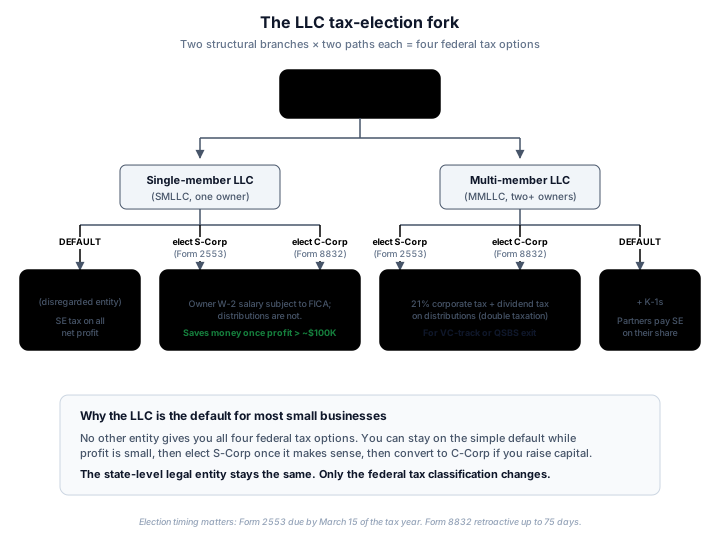
Option 1: SMLLC default (disregarded entity / Schedule C)
For a single-member LLC, the IRS taxes the business as a sole proprietorship by default. Profit lands on Schedule C of the owner's 1040; SE tax applies to all net profit; income tax applies on top.
When to choose this: by default, no action required. Right for most freelancers, consultants, side-hustlers, and solo service businesses with profit under ~$100,000.
Option 2: MMLLC default (partnership taxation)
For a multi-member LLC, the IRS taxes the business as a partnership by default. The LLC files Form 1065 (an information return), and issues a Schedule K-1 to each member showing their share of profit, loss, and certain other items. Each member then reports their K-1 on their personal 1040 and pays SE tax on their distributive share.
When to choose this: by default, no action required. Right for most multi-owner small businesses where ownership is reasonably stable and members are individuals or trusts (not corporations).
Option 3: S-Corp election (Form 2553)
Either an SMLLC or MMLLC can elect S-Corp tax treatment by filing Form 2553. The LLC then files Form 1120-S as an S-Corp; owners receive both W-2 wages (subject to FICA) and distributions (not subject to FICA).
When to choose this: once profit reliably exceeds ~$100,000 and you can defend a reasonable salary that's less than total profit. See The S-Corp Election: How and When It Saves Money for the full math.
Option 4: C-Corp election (Form 8832 + 1120)
An LLC can elect to be taxed as a C-Corp by filing Form 8832 (entity classification election). The LLC then files Form 1120 as a C-Corp; profit is taxed at 21% at the entity level, and again as dividends when distributed.
When to choose this: rarely. The main scenarios are: (a) you're raising venture capital and need the corporate tax treatment for legal cleanliness, (b) you're retaining most profits inside the entity for years to fund growth, or (c) you're planning a Section 1202 / QSBS exit (see The C-Corporation: When It's the Right Trade-off). For most small businesses, this is the wrong choice.
What the liability shield actually protects
The "limited liability" in LLC is a real benefit, but it's narrower than people assume. Here's what it covers and what it doesn't.
What the LLC shield protects against
The LLC shield generally protects your personal assets (house, car, savings, retirement accounts) from claims against the business, including:
- Contract disputes with vendors, customers, or service providers
- Slip-and-fall and similar premises liability
- Most employee-caused incidents (the business is the employer, not you personally)
- Business debts the entity owes
- Most product liability claims (depends on your role)
If a customer sues the business and wins a $100,000 judgment, they can collect from business assets. They cannot generally collect from your personal bank account.
What the LLC shield does NOT protect against
The shield does not cover:
- Your own personal misconduct. If you commit malpractice, fraud, or a tort yourself (e.g., a designer who plagiarizes, a consultant who gives intentionally bad advice, a contractor who damages a client's property), you can be sued personally regardless of the LLC.
- Personal guarantees. Most small business loans, leases, and credit cards require a personal guarantee. The LLC doesn't shield you from those because you've explicitly waived the shield by signing.
- Unpaid payroll taxes. The IRS can assess "trust fund recovery penalties" against responsible owner-employees personally for unremitted withholding tax. The LLC doesn't help.
- Fiduciary duty breaches to other members. If you, as a member, breach your duties to fellow members, they can sue you personally.
- Acts that pierce the corporate veil. Courts can disregard the LLC and hold members personally liable if the entity is treated as a sham.
Veil piercing: how to lose the shield
Courts pierce the LLC shield (sometimes called "piercing the corporate veil" even though it's actually an LLC) when the owner has not respected the entity as separate. The classic factors:
- Commingling: paying personal expenses from the business account or vice versa
- Undercapitalization: starting the business with insufficient capital for its expected obligations
- Failure to maintain formalities: no operating agreement, no separate bank account, no records of major decisions, no written contracts
- Fraud: using the LLC to evade existing creditors or to perpetrate a fraud
The practical implication: the LLC shield is a habit, not a one-time form. Forming the LLC is 5% of the work. Maintaining it (separate accounts, written contracts under the LLC's name, contemporaneous records of decisions) is the other 95%.
Formation costs and the state-by-state landscape
Filing an LLC is straightforward in every state, but the costs and ongoing requirements vary materially.
| State | Formation fee | Annual cost | Notes |
|---|---|---|---|
| Delaware | $90 | $300 (franchise tax) | Default for VC-track companies. Privacy of ownership |
| Wyoming | $100 | $60 | Lowest annual cost; strong asset protection laws |
| Florida | $125 | $138.75 | No state income tax; popular for relocators |
| Texas | $300 | $0 (most LLCs) | Franchise tax kicks in above $1.23M revenue |
| Nevada | $425 | $350 | Often cited as "tax haven" but compliance costs are higher than advertised |
| New York | $200 | ~$1,500 first year | Publication requirement (advertising in two newspapers for 6 weeks) |
| California | $70 | $800 minimum (franchise tax) + LLC fee | The most expensive state for LLCs |
The two states worth flagging:
-
California charges every LLC a minimum $800/year franchise tax regardless of profit, plus an LLC fee that ranges from $0 to $11,790 based on revenue. If you live in California and form an LLC for a side gig making $5K a year, you're losing money on the franchise tax. There is no first-year exemption since 2024 (briefly was during COVID; that ended).
-
New York has a unique publication requirement: you must publish a notice of your LLC's formation in two newspapers (one daily, one weekly) in the county where the LLC is registered, for six consecutive weeks. The cost ranges from a few hundred dollars in upstate counties to $1,500+ in Manhattan.
For most small business owners, the right state to form in is the state where you live and operate. Forming in Delaware or Wyoming when you live in California sounds clever but creates "foreign qualification" obligations (you'd still need to register as a foreign LLC in California and pay the $800 anyway). The "tax shelter LLC formation in another state" advice on social media usually doesn't apply to operating businesses.
The operating agreement (the most underrated document)
Most online LLC formation services let you check a box that says "skip operating agreement." Don't.
The operating agreement is the contract that governs:
- Ownership and capital contributions: who owns what percentage and what they put in
- Profit and loss allocation: how income flows to members (often, but not always, in proportion to ownership)
- Decision-making rights: which decisions need unanimous consent vs. majority vote
- Distributions: when and how money moves from the LLC to members
- Buy-sell provisions: what happens if a member dies, divorces, files bankruptcy, or wants to sell
- Dispute resolution: arbitration, mediation, governing law
- Dissolution: how to wind down the LLC if things go bad
For a single-member LLC, the operating agreement might be a 2-page document. It still matters because:
- It strengthens the liability shield (courts give weight to entities that have a written operating agreement)
- It gives you a place to record capital contributions and the original ownership structure (useful for future tax/audit work)
- It avoids confusion if you ever sell the LLC, take on a partner, or pass it on
For a multi-member LLC, the operating agreement is the most important document the LLC will ever produce. Most "two friends started a business and one ended up owning everything" stories trace back to no operating agreement, or a generic template that didn't address the actual issues.
The free templates online are a starting point; for any multi-member LLC with material assets or revenue, paying a lawyer $1,500 to $3,000 for a custom operating agreement is one of the best money-saving decisions you can make.
Annual maintenance: what you actually have to do
Not much, but not nothing. The annual maintenance for a typical SMLLC:
- File your state annual report (called annual report, statement of information, or biennial report depending on the state). Most states charge $0 to $50; some do not require one at all.
- Pay any annual fees or franchise taxes (the $800 in California, $300 in Delaware, etc.).
- File your federal tax returns: Schedule C for SMLLC default, 1065 + K-1s for MMLLC default, 1120-S for S-Corp election, 1120 for C-Corp election.
- Maintain a registered agent: the person or service authorized to receive legal mail. If you formed in your home state at your home address, you may already be your own registered agent. If you formed elsewhere or want privacy, $50 to $300/year for a registered agent service.
- Keep basic books: separate bank account, basic accounting (even a spreadsheet works), categorize income and expenses.
If you skip the basics (no separate account, no books, no annual report), you risk administrative dissolution by the state and weaken your liability shield. The cost of doing it right is small. The cost of doing it wrong is real.
Worked example: a two-partner consulting LLC
Anna and Ben form a marketing consulting business in Texas as a multi-member LLC. They each contribute $5,000 in initial capital and split ownership 50/50. Their first-year financials:
- Revenue: $220,000
- Expenses (software, contractors, marketing, office): $40,000
- Net profit: $180,000
Year 1 federal tax flow
The LLC files Form 1065 as a partnership (the default for multi-member LLCs). Each partner gets a Schedule K-1 showing $90,000 of distributive share (50/50 split).
On their personal returns:
- Anna reports $90,000 on her 1040
- Anna pays SE tax: $90,000 × 0.9235 × 15.3% = $12,720
- Anna pays income tax on the $90,000 (less the half-SE deduction)
Ben's situation is identical. The total federal tax burden across both partners is the same as it would be for two solo consultants each making $90,000 of profit.
Year 2 considering an S-Corp election
After 18 months of strong profit, Anna and Ben work with a CPA to model an S-Corp election. With combined profit projected at $250,000 for year 2:
- As a partnership: $250K × 0.9235 × ~12.5% (averaging Medicare-only above wage base) ≈ ~$28,000 in SE tax across both partners
- As an S-Corp: each pays themselves a $80,000 reasonable salary ($160K total), distributions of $90,000 across both. FICA = $160K × 15.3% = ~$24,500. Compliance ~$3,000 (S-Corp filings, payroll for two employees).
- Annual savings: roughly $500-$1,500, which is marginal at this scale.
In their case, the S-Corp election barely pencils because both partners need defensible salaries and the compliance cost is doubled (two W-2 employees instead of one). They decide to wait until profit reaches $400K+ before electing.
This is a useful insight: the S-Corp election math gets tougher with multi-member LLCs because you're paying compliance for multiple W-2 setups. Many two-partner LLCs find the math doesn't work as cleanly as for a single-member LLC at the same total profit.
Common mistakes that hurt LLCs
-
Treating the LLC as a personal piggy bank. Paying personal expenses from the business account, transferring money randomly, no separate cards. This is the most common veil-piercing factor and the easiest to avoid.
-
Skipping the operating agreement. "We trust each other" is fine until someone wants out, dies, divorces, or pivots the business in a direction the other partner doesn't want. Then it's not fine.
-
Ignoring the registered agent. If your registered agent moves or you forget to update them, legal mail (lawsuits, tax notices) can go unanswered, leading to default judgments and administrative dissolution.
-
Not capitalizing the LLC adequately. Funding an LLC with $100 and then taking on $100,000 of obligations is a piercing factor. Treat the LLC like a real entity: contribute reasonable capital, document it.
-
Forgetting state annual reports. Many states administratively dissolve LLCs that miss reports. Reinstating costs more than just filing on time.
-
Forming in Wyoming/Delaware/Nevada because of social media advice. If you operate in California, you owe the $800 California franchise tax whether you formed in California or registered there as a foreign LLC. The "form-in-Wyoming-to-save-money" play almost never works for an operating business.
Read related guides in the cluster
- Choosing a Business Entity: the pillar that puts the LLC in context with sole props, partnerships, S-Corps, and C-Corps
- Sole Proprietorships and General Partnerships: the alternative defaults that most LLCs are an upgrade from
- The S-Corp Election: How and When It Saves Money: the most common tax election an LLC makes
- The C-Corporation: When It's the Right Trade-off: when a C-Corp is structurally better than an LLC + S-Corp election
- Self-Employment Tax: the tax that drives LLC structuring decisions for most owners
- Owner Draws and Contributions: how owner equity flows through an LLC's books
Key takeaway
The LLC is the right entity for the majority of small businesses, not because it's the cheapest or the most tax-efficient, but because it gives you liability protection without committing you to any particular tax treatment. You get to decide how to be taxed (default pass-through, S-Corp, C-Corp) based on what makes sense at your current stage.
Three habits make the LLC actually work:
- Treat the entity as real. Separate bank account, separate cards, written contracts under the LLC's name, no personal expenses on the business card. The shield is a habit, not a form.
- Have an operating agreement. Even for solo owners. Especially for multi-member. The cost is small; the value when something goes wrong is enormous.
- Re-evaluate the tax election as profit grows. Default pass-through works at any profit level, but at ~$100K and above, the S-Corp election usually pays for itself.
The LLC is boring. That's a feature. Most small businesses do not need a clever entity structure; they need a stable, well-run LLC and the discipline to keep it separate from the owner's personal life.
References
- IRS: Limited Liability Company (LLC): federal tax classification overview
- IRS Form 8832: Entity Classification Election: the form to elect C-Corp tax treatment for an LLC
- IRS Form 2553: Election by a Small Business Corporation: the form to elect S-Corp tax treatment
- SBA: Limited Liability Company: the Small Business Administration's overview
- California Franchise Tax Board: LLCs: the $800 minimum franchise tax mechanics
Disclaimer
LLC formation, operating agreements, and tax elections have legal and financial implications that vary by state, industry, and personal circumstances. State filing fees, franchise taxes, professional licensing requirements, and federal tax classification rules change and may be revised by future legislation. The "veil piercing" doctrine is a fact-specific common-law doctrine that varies by jurisdiction. This guide explains the framework at a high level and is not legal, tax, or financial advice. Consult a licensed attorney and CPA in your state before forming, modifying, or dissolving an LLC.
Try it in Sedna
See this in action in the app. Open in app