
Sole Proprietorships and General Partnerships
A practical guide to the two cheapest, most common, and most dangerous default entities: sole proprietorships and general partnerships. What each one is, when they make sense (briefly), the accidental-partnership trap that catches thousands of people a year, and exactly when to upgrade to an LLC.
12 min readPublished
The cheapest entities are also the most dangerous, and most people don't realize they're in one.
A sole proprietorship is what you become the moment you earn a dollar of side-hustle income without forming anything else. A general partnership is what two of you become the moment you decide to "split the profits 50/50" without forming anything else. There is no paperwork, no fee, no formal moment of creation. You just are one. And both come with unlimited personal liability: your house, your car, your savings are exposed.
This guide explains what these defaults actually are, the accidental-partnership trap that catches thousands of people every year, when sole proprietorship is genuinely fine, and exactly when you should upgrade to an LLC. The goal is not to convince every reader to form an LLC tomorrow, but to make sure you understand the trade-offs of staying in the default.
This is a deep-dive in the Choosing a Business Entity cluster.
At a glance
- A sole proprietorship is the default for any solo person earning self-employment income without forming an LLC or corporation. No formation required; report on Schedule C; pay self-employment tax on net profit
- A general partnership is the default for two or more people doing business together with no formation paperwork. The handshake itself is the entity. Both partners are personally liable for everything the other partner does
- Both have unlimited personal liability. The "low cost" of these entities trades real dollars for real legal exposure. A single lawsuit can take your house and savings
- The accidental general partnership is the most dangerous default: two friends starting a side project together default into one without realizing it. The fix is forming an LLC and signing a real operating agreement
- When sole prop is genuinely fine: side gigs under $5K-$10K/year, low-risk activities (writing, tutoring, basic services), no customer-facing premises, no contractual obligations to businesses
What a sole proprietorship actually is
A sole proprietorship is the default federal tax classification for any individual earning money from their own business activity, with no entity formed. There is no application, no filing, no formation event. You become a sole proprietor the moment you earn your first dollar of self-employment income.
The IRS does not treat the sole proprietorship as separate from you. Your business income lands on Schedule C of your personal 1040. Your business expenses come off the same Schedule C. The net profit (or loss) flows to your 1040, where it's:
- Subject to self-employment tax (15.3% on the first $176,100 in 2025, plus 2.9% Medicare beyond that, with an additional 0.9% above $200K single / $250K married)
- Added to your ordinary income for federal income tax
- Subject to state income tax (in most states)
For tax purposes, you and your sole proprietorship are the same taxpayer. The "business" doesn't exist as a separate entity in the IRS's eyes.
What you might still need to file (even as a sole prop)
Even though there's no entity formation, sole proprietors often need:
- A local business license from your city or county, depending on industry. Costs typically $25-$200/year.
- A DBA (doing business as) registration if you operate under a name other than your legal name. ("Jane Smith Consulting" likely doesn't need one; "Acme Marketing" does.)
- A sales tax permit if you sell taxable goods or certain taxable services.
- Industry-specific licensing for regulated fields (cosmetology, real estate brokerage, contracting, food service, healthcare, etc.).
- An EIN (Employer Identification Number) from the IRS if you hire employees, file certain tax forms, or want to avoid using your SSN on business paperwork. Free, takes 10 minutes online.
None of these change your federal tax classification. You are still a sole proprietor; you're just a sole proprietor who is properly licensed.
What a general partnership actually is
A general partnership is the default classification when two or more people carry on a business together for profit, with no entity formed. Like the sole prop, there is no formation requirement. Two people deciding to split profits is the entity.
In most states, the controlling law is some version of the Uniform Partnership Act (UPA) or the Revised Uniform Partnership Act (RUPA). These statutes define a partnership as "an association of two or more persons to carry on as co-owners a business for profit." The intent is what matters; you don't need to call it a partnership for it to be one.
The legal default rules (when there's no agreement)
If you don't sign a partnership agreement, state law fills in the blanks:
- Profit and loss split: equally among partners, regardless of capital contribution or work hours
- Decision-making: majority vote on ordinary business; unanimous on extraordinary matters (e.g., admitting new partners, dissolving)
- Authority: each partner can bind the partnership to contracts and obligations
- Liability: unlimited and joint and several for all partnership obligations (more on this below)
- Dissolution: partnership dissolves automatically on the death, withdrawal, or bankruptcy of any partner (in most states)
These defaults are rarely what the partners actually want. The 50/50 split is fine until one person is doing 80% of the work. The automatic dissolution is fine until one partner takes a six-week vacation and the other partner thinks they've quit. The unlimited liability is fine until something goes wrong, and then it's catastrophic.
Federal tax treatment
For federal tax purposes, a general partnership is a pass-through entity:
- The partnership files Form 1065 (an information return), reporting total business income, deductions, and credits
- Each partner receives a Schedule K-1 showing their distributive share of the partnership's income, deductions, and credits
- Partners report the K-1 on their personal 1040 and pay self-employment tax on their distributive share of ordinary partnership income
- The partnership itself owes no federal income tax
This is the same general structure as a multi-member LLC's default tax treatment (the IRS taxes both the same way). The legal structure differs dramatically (the LLC has liability protection; the GP does not), but the federal tax forms are essentially identical.
The unlimited-liability problem
This is the section that determines whether sole prop and GP are right for you.
Sole prop liability exposure
If you operate as a sole proprietor and:
- A client claims your work damaged their business → they can sue you personally
- Someone trips on your premises (if you have any) → they can sue you personally
- A vendor delivers $50,000 in goods you can't pay for → they can sue you personally
- A subcontractor you hired causes property damage → you can be sued personally
In all these cases, "the business" is just you. Your personal assets (house, car, savings, retirement) are at the same level of exposure as your business assets.
What this looks like in practice: a small contractor sole prop accepts a $20,000 kitchen remodel job. The contractor's subcontractor cuts a water line, causing $80,000 in damage. The homeowner sues. The contractor's small umbrella insurance covers $25,000. The remaining $55,000 is collected by garnishing the contractor's personal wages and forcing the sale of their personal vehicle. This is not a hypothetical; it's a typical small-business outcome.
Insurance helps but doesn't replace the entity protection. General liability insurance has limits (typically $1-2M per occurrence). Errors and omissions covers professional mistakes but not contract disputes. Many lawsuits exceed insurance coverage, and the gap falls on personal assets in a sole prop.
General partnership liability exposure
Sole prop liability is bad. General partnership liability is worse.
In a general partnership, each partner has unlimited joint and several liability for partnership obligations. "Joint and several" means a creditor can collect the entire amount from any one partner, regardless of how the partners split profits internally.
What this looks like in practice:
- Your partner signs a $500K vendor contract you didn't know about. The vendor sues. They can collect the entire $500K from you, even if your partnership agreement said you'd split obligations 50/50. (You can sue your partner for their half, but that's a separate fight, and you might lose.)
- Your partner causes a car accident while driving on a partnership errand. The injured party sues. You're personally liable, and the partnership's insurance limits don't cap your personal exposure.
- Your partner embezzles from a customer. The customer sues the partnership. You're on the hook for the customer's loss.
- Your partner files personal bankruptcy. Their interest in the partnership becomes a creditor's asset, potentially forcing dissolution and exposing you to additional claims.
The partner you trust with your career is not the variable that matters. The variable that matters is what your partner does, day to day, in the name of the business. Even a careful, honest partner can sign a bad contract or have an at-fault accident.
The accidental general partnership trap
The most dangerous version of this is the accidental GP. Two people start doing something together with shared profits and no entity. They never sign anything calling it a partnership. They might not even use the word.
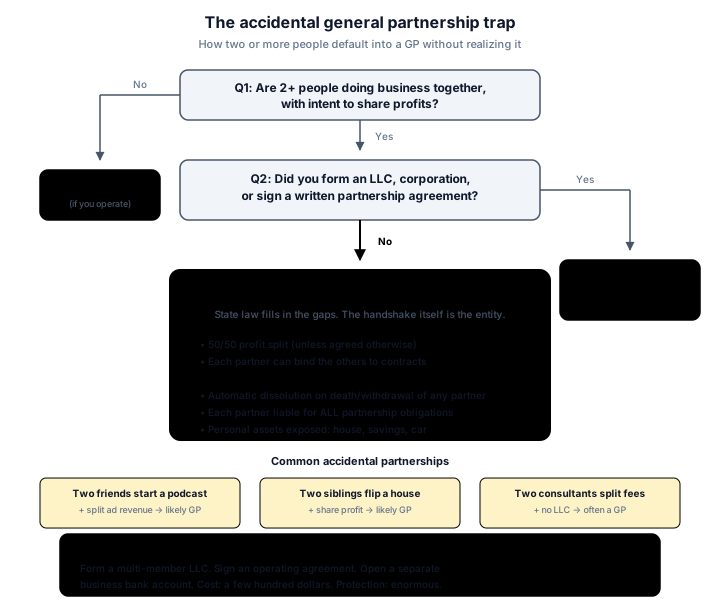
Examples of accidental GPs we see all the time:
- Two friends start a podcast and split ad revenue
- Two consultants split a project fee without an entity to receive payments
- Two siblings flip a house together, splitting profit
- Two designers freelance jointly under one brand name
- Two cousins run an Etsy shop, sharing profits
- A husband-and-wife team runs a side business without forming anything (often, but not always, this is a "qualified joint venture" rather than a partnership; rules are complex and state-specific)
In all of these, the law treats the participants as general partners by default. They have unlimited joint and several liability, even though they never signed anything calling themselves a partnership. The biggest legal exposure most casual co-founders carry is one they don't know they have.
The fix is so simple: form a multi-member LLC, sign an operating agreement, open a separate business bank account. Cost: a few hundred dollars. Time: a couple of hours of paperwork. The legal protection difference is enormous.
When a sole proprietorship is genuinely fine
Despite the liability exposure, the sole proprietorship is the right answer for many situations. The cases where it makes sense:
| Situation | Why sole prop works |
|---|---|
| Side gig under $5K-$10K/year | Liability exposure is low; LLC overhead exceeds the benefit |
| Tutor, writer, editor, freelance researcher | Limited counterparty risk; work is mostly intellectual |
| Online creator earning ad revenue or affiliate income | No customer-facing premises, contracts are mostly platform terms |
| Selling crafts at occasional markets, low volumes | Liability covered by simple general liability insurance |
| Newly testing a business idea (first 6-12 months) | Form an LLC once you've validated demand and have real income |
| Author or consultant working through a personal name | Reputation and contracts are personal; LLC doesn't add much |
In all of these, the activity:
- Has limited liability exposure (no premises, no employees, no contracts that could lead to large judgments)
- Has profit too small to justify $50-$300 in formation fees and $0-$800/year in maintenance
- Is potentially temporary (you're testing a thing; if it works, you'll upgrade)
The mistake is staying in sole prop too long. A growing freelance practice that crosses $30K-$50K of annual profit and starts working with business clients should usually upgrade to an LLC within 6 to 12 months.
When a general partnership is genuinely fine
Almost never. The general partnership is essentially never the right answer for two reasons:
- The legal exposure is too high. Joint and several liability is worse than sole prop liability. There's no scenario where you want each partner personally on the hook for the other partner's mistakes.
- The fix is trivial. A multi-member LLC has the same federal tax treatment as a partnership (default partnership taxation) but adds the liability shield. Forming costs a few hundred dollars. Refusing to do this to save $300 is one of the worst tradeoffs in small-business law.
The only legitimate scenarios for staying in a general partnership:
- One-time projects where you and a partner are splitting profit on a single deal (e.g., co-authoring a book, jointly buying a single piece of property, splitting profit on a single client engagement). Even here, an LLC is often cleaner.
- Family businesses with very low risk, very low revenue, and a long history of operating without incident. Even here, the upgrade to LLC is usually cheap insurance.
- Existing partnerships you're winding down where forming an LLC just to dissolve it is more cost than benefit.
For any active, ongoing, two-or-more-person business with material economic activity, the right answer is an LLC. Always.
Worked example: when to upgrade
David is a freelance graphic designer in Texas. He's been operating as a sole prop for 14 months. His situation:
- Year 1: $32,000 in revenue, $7,000 in expenses, $25,000 net profit
- Year 2 (projected): $58,000 in revenue, $10,000 in expenses, $48,000 net profit
- Clients: a mix of individuals (small) and small businesses ($5K-$15K projects)
- Risks: occasional contractual liability for delivering work; no premises; no employees
Sole prop year 2 tax flow
- Schedule C: $48,000 net profit
- SE tax: $48,000 × 0.9235 × 15.3% = $6,783
- Half-deduction: $3,391
- Income tax (assume 22% effective on the post-deduction amount): roughly $9,800
- Total federal tax: ~$16,600
What changes with an LLC
David forms a Texas single-member LLC for the upcoming year:
- Filing fee: $300 (one-time)
- Annual report: $0 (Texas)
- Operating agreement: $0 (he uses a free template; spends 30 minutes adapting it)
- Separate bank account: free
- Total LLC cost: $300 in year 1, ~$0/year ongoing
What stays the same
David's federal tax bill is unchanged. As a single-member LLC, he's still a disregarded entity for federal tax purposes. Same Schedule C, same SE tax, same income tax. The federal $16,600 doesn't move.
What changes
- David's contracts now run from his LLC to his clients, not from him personally
- His business bank account is in the LLC's name
- If a client sues over a project gone bad, his personal assets are protected (subject to maintaining the formalities)
- He looks more professional to business clients, who often prefer working with entities
- He has cleaner books because business and personal finances are now physically separated
For $300 one-time and a couple of hours of paperwork, David has eliminated a meaningful slice of personal liability exposure with no ongoing tax cost. This is the typical "upgrade from sole prop to LLC" calculation, and it almost always pencils once you cross $25K-$30K of net profit.
The same calculation in California would be different: California's $800/year minimum franchise tax adds real cost. David at $48K profit would still benefit from forming, but the math is tighter; the break-even logic shifts from "almost everyone should upgrade" to "upgrade once profit is meaningful and risk is real."
Common mistakes
-
Staying in sole prop too long. A growing freelance practice working with business clients should upgrade well before profit reaches $50K. The marginal cost is small; the personal liability exposure is real.
-
Operating as an accidental general partnership. Two friends doing a project together with shared profit and no entity is the most common preventable mistake in small business law. Form an LLC. Sign an operating agreement. Take an afternoon.
-
Skipping the local business license. Most cities require a business license (sometimes called a tax certificate or occupation tax) for any commercial activity. Penalties for operating without one are usually small but compound, and an unlicensed business can have trouble enforcing contracts.
-
Operating under a name that's not yours without a DBA. "John Smith Consulting" usually doesn't need a DBA; "Apex Marketing" does. Banks won't open an account in a name that doesn't match your DBA filing or your entity formation document.
-
Mixing personal and business finances. Even as a sole prop, separate bank accounts and clear records make tax filing easier and audit-defensible. Mixing makes both harder.
-
Assuming insurance replaces an LLC. General liability insurance covers many things but not all things, and policy limits can be exceeded. The LLC is a separate layer of protection, not a replacement for insurance.
-
Forming an LLC then operating like a sole prop. Forming the entity is 5% of the work. Maintaining separation (separate accounts, written contracts under the LLC's name, no commingling) is the other 95%. A formed LLC with no operating discipline is just a sole prop with extra paperwork.
Read related guides in the cluster
- Choosing a Business Entity: the pillar guide that puts these defaults in context with LLCs, S-Corps, and C-Corps
- The LLC: How It Works and When to Use It: the upgrade path for almost every sole prop and GP that grows beyond a side gig
- The S-Corp Election: How and When It Saves Money: the next decision after LLC formation, once profit reliably exceeds $100K
- Self-Employment Tax: the tax that drives most sole-prop and partnership economics
- Owner Draws and Contributions: how owner equity flows work in pass-through entities
Key takeaway
Sole proprietorship and general partnership are the cheapest entities and, for most purposes, the worst trade-off. They cost nothing because they offer nothing: no liability protection, no tax flexibility, no separate identity. The "free" entity is rarely the right entity once your business has any meaningful revenue or risk.
Three rules that prevent the worst outcomes:
- Sole prop is fine for small side gigs and early-stage testing, but upgrade to an LLC once profit reaches ~$30K and you're working with business clients or carrying any contractual liability.
- Never stay in a general partnership voluntarily. The fix is a multi-member LLC. The cost is a few hundred dollars. There is no scenario where the GP is the better answer for an ongoing business.
- Watch for the accidental partnership. Two people sharing profits without an entity is a partnership by default. Form an LLC the day you decide to do something jointly.
The default entities are everywhere because they're free. They're free because they offer no protection. Once you have something worth protecting (income, customers, savings, a house), the upgrade is almost always worth it.
References
- IRS: Sole Proprietorships: federal tax treatment overview
- IRS: Partnerships: federal tax treatment for general partnerships
- Uniform Partnership Act (RUPA): the model statute most states have adopted for general partnership law
- SBA: Choose a Business Structure: Small Business Administration's overview
- IRS Schedule C: the form used to report sole-proprietorship income
Disclaimer
Sole proprietorship and general partnership classifications are governed by federal tax law and state common law. The "accidental partnership" doctrine and joint-and-several liability rules vary by state and are interpreted by courts based on the facts of each situation. Local licensing, DBA, and tax permit requirements vary by city and industry. This guide explains the framework at a high level and is not legal, tax, or financial advice. Consult a licensed attorney and CPA in your state before making decisions about entity formation, partnership relationships, or upgrading to a different entity type.
Try it in Sedna
See this in action in the app. Open in app