
Choosing a Business Entity: A Decision Guide
A plain-English guide to choosing between sole proprietorship, partnership, LLC, S-Corp election, and C-Corp. The five dimensions you're actually choosing between, a decision tree, and the four mistakes that cost founders the most.
14 min readPublished
Two founders make the same product. One forms an LLC because every business article on the internet says to form an LLC. The other forms a sole proprietorship because it's free and they're not sure the business will work.
Two years later, one is being sued because they did not separate business and personal assets. The other is paying $800 a year in California franchise tax for an LLC they barely use, and is genuinely confused about whether they should "switch to an S-Corp." Both wish someone had explained this to them in plain English at the start.
That is what this guide does. We will walk through the five dimensions you are actually choosing between, give you a decision tree, compare the five entity types side by side, and call out the four mistakes that cost founders the most. By the end you will have a clear default for your situation and a working understanding of when to revisit the decision.
This guide is written for freelancers, small business owners, and first-time founders, not for lawyers or CPAs. Where the answer is "it depends," we will say so and tell you what it depends on.
At a glance
- You're really choosing between five dimensions: liability protection, tax treatment, formation/maintenance cost, ability to raise outside capital, and exit optionality. No single entity wins on all five
- Most small businesses should form an LLC. It's the right default for the 60-70% of cases that aren't side hustles, partnerships of equals, or VC-track startups
- An S-Corp is not an entity type. It's a federal tax election (Form 2553) that an LLC or corporation can make. Consider it once net profit reliably exceeds ~$100K
- A C-Corp is the right choice if and only if you're raising venture capital or planning a large exit (Section 1202 / QSBS only applies to C-Corps). Otherwise the double taxation costs more than it saves
- The decision is mostly reversible. Start where you are, upgrade as the business grows. The expensive mistakes are accidentally forming a general partnership, missing the Form 2553 deadline, and forming a C-Corp without a real reason
The five things you're actually choosing between
Most "what entity should I form" articles jump straight to comparing tax treatment. That misses what actually matters. There are five dimensions every entity type makes a different trade-off on. The right entity for you is the one that wins on the dimensions that matter to your situation.
1. Liability protection
Can a customer who slips on your floor, a client who claims your work damaged their business, or a vendor you can't pay come after your personal assets (your house, savings, car), or only your business assets?
| Entity | Liability protection |
|---|---|
| Sole proprietorship | None. You are the business. Your personal assets are exposed |
| General partnership | None, and worse: you're liable for what your partner does too (joint and several liability) |
| LLC (single or multi-member) | Strong, but conditional on respecting the entity (no commingling, proper records) |
| S-Corp election | Same as the underlying entity (LLC or corporation) |
| C-Corp | Strong, same conditional rules apply |
The "conditional" word matters. LLC and corporate liability protection can be pierced by courts if you treat the entity as a personal piggy bank: paying personal expenses from business accounts, never holding meetings or signing operating agreements, undercapitalizing the business. The protection is real, but you have to maintain it.
2. Tax treatment
How does the IRS tax the business's profit?
| Entity | Federal tax treatment |
|---|---|
| Sole prop / Single-member LLC (default) | Pass-through. Business profit lands on owner's Schedule C → owner's 1040 |
| Partnership / Multi-member LLC (default) | Pass-through via Form 1065 + K-1s to each partner |
| LLC with S-Corp election | Pass-through via Form 1120-S, but salary subject to FICA, distributions are not |
| C-Corp | Two-layer. Corporate income taxed at 21%, then dividends/distributions taxed again at the shareholder level |
The big distinction: pass-through entities are taxed once on the owner's individual return; C-Corps are taxed twice (once at the corporate level, then again when money moves to the owner). Pass-through is simpler for most small businesses; C-Corp is structurally better only when you reinvest most profits or when investor preferences require it.
For pass-through entities, owners also pay self-employment tax on business profit, which is the equivalent of FICA for the self-employed. The S-Corp election is the most common way to legally reduce SE tax exposure.
3. Formation and maintenance cost
What does it cost to start and keep the entity alive each year?
| Entity | One-time cost | Recurring annual cost |
|---|---|---|
| Sole proprietorship | $0 federal, maybe $25-$100 for a local business license | Usually nothing |
| General partnership | $0 (you can form one by accident) | Usually nothing |
| LLC | $50-$300 (state filing fee) | $0-$800 depending on state |
| S-Corp election (on top of LLC) | $0 (Form 2553 is free) | $1,500-$3,000 (payroll, 1120-S filing, often a CPA) |
| C-Corp | $100-$500 (state filing + registered agent) | $300-$2,500 (state fee + tax filings + often a CPA) |
The big cost gotcha is California's $800 minimum franchise tax, which applies to every LLC and corporation registered there regardless of profit. If you live in California and form an LLC for a business making $5K a year, you're losing money on the franchise tax. (More on this in the LLC and S-Corp deep-dives.)
4. Ability to raise outside capital
Can you take outside money: angel investors, venture capital, a small business loan, friends-and-family equity?
| Entity | Capital-raising fit |
|---|---|
| Sole proprietorship | Loans only. Cannot sell equity (you have no shares) |
| Partnership / LLC | Loans + selling membership interests (clunky for institutional investors) |
| C-Corp | Built for outside equity. Stock classes, preferred shares, convertible notes, SAFEs all standard |
This is the dimension that matters most if you have a VC-track startup. Investors fund Delaware C-Corps almost exclusively because the legal mechanics are familiar and the case law is settled. If you're raising venture money, you will end up as a Delaware C-Corp eventually, and forming as anything else just means a conversion later.
5. Exit / sale optionality
What happens if you sell the business in 3-10 years?
| Entity | Exit characteristics |
|---|---|
| Sole prop / Partnership / LLC | Asset sale typical. Owner pays ordinary income + SE tax on the gain |
| S-Corp | Stock sale possible; 5-year "built-in gains" tax if recently converted from C-Corp |
| C-Corp | Section 1202 / QSBS allows up to $10 million of gain tax-free if held 5+ years and other tests met. Massive perk for founders |
The QSBS / Section 1202 perk is the under-appreciated reason VC-backed founders form C-Corps even when the double-taxation math looks worse on paper. If you exit for $10M+ after 5 years, the tax savings pay for everything.
The decision tree
Most small business owners should not need to think about all five dimensions equally. Here's the short flowchart for the decision:
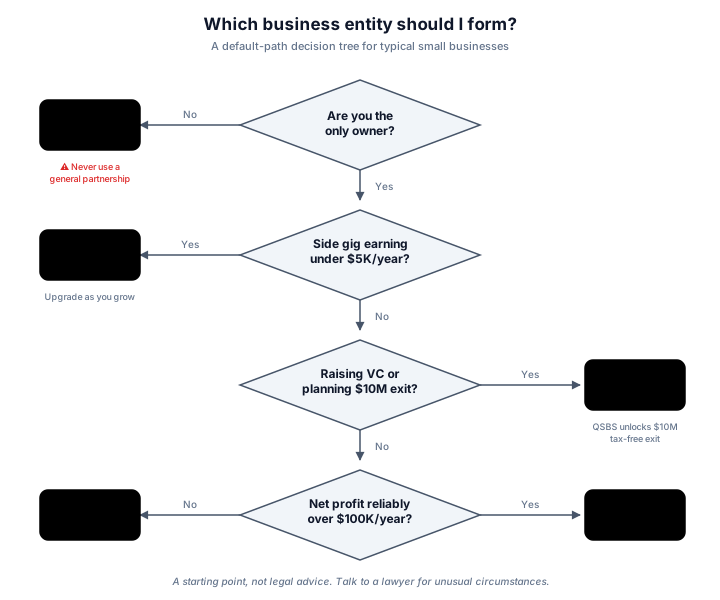
The tree captures roughly 90% of cases. The 10% it does not cover are: regulated industries (medicine, law, finance, real estate brokerage often have state-mandated entity types like PLLCs), real estate investing (different rules around passive losses and 1031 exchanges), foreign owners (S-Corps require US persons), and businesses operating in multiple states (which can require qualifying the entity in each).
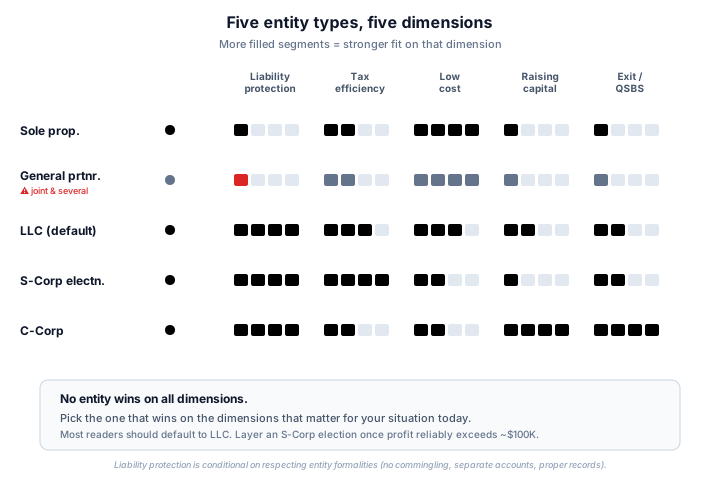
The five entity types at a glance
| Sole prop | General partnership | LLC | S-Corp election | C-Corp | |
|---|---|---|---|---|---|
| Owners allowed | 1 | 2+ | 1+ | 1-100 (US persons only) | Unlimited |
| Liability protection | None | None | Strong* | Strong* (entity-dependent) | Strong* |
| Federal tax | Pass-through (Sched C) | Pass-through (1065 + K-1) | Pass-through (default) | Pass-through, salary + distribution split | Two-layer (21% corp + dividend tax) |
| Self-employment tax | Yes, on all profit | Yes, on distributive shares | Yes (default) | Only on salary portion | No (W-2 wages only) |
| Formation cost | $0 | $0 | $50-$300 | $0 (Form 2553) | $100-$500 |
| Annual cost | $0 | $0 | $0-$800 | $1,500-$3,000 | $300-$2,500 |
| Easy to raise VC? | No | No | Awkward | No | Yes |
| QSBS / $10M tax-free exit? | No | No | No | No | Yes |
* Liability protection is conditional on respecting entity formalities (no commingling, proper records, adequate capitalization).
Why most people get this wrong
Four mistakes account for most of the entity-selection regret we see in real businesses.
Mistake 1: "Forming an LLC will save me on taxes"
This is the most common myth in small business formation. A single-member LLC taxed as a sole proprietor (the default) pays exactly the same federal tax as a sole prop with no LLC. The LLC is a state-level legal entity; it provides liability protection and a separate identity, but it does not change the federal tax calculation by itself.
Tax savings come from what you do inside the LLC (electing S-Corp status, retirement plan contributions, accountable plan reimbursements), not from the LLC itself. Forming an LLC because "everyone says it saves taxes" without taking any of those follow-on actions just gets you the liability protection at the cost of the state filing fee.
Mistake 2: "We're starting this together, let's just split profits 50/50"
Two people doing business together with the intent to share profit have, by default in most states, formed a general partnership. No paperwork required. The handshake itself is the entity.
This matters because GPs have unlimited joint and several liability, meaning each partner is personally liable not just for their own actions but for everything their partner does in the name of the business. If your business partner racks up debt, signs a contract you didn't know about, or causes an accident on the job, your personal assets are on the line.
The fix is simple: form an LLC instead. The cost is a few hundred dollars and an operating agreement. Two friends launching a podcast, splitting Etsy revenue, building software together, or starting a consulting practice should all be LLCs, not handshake-formed GPs.
Mistake 3: Electing S-Corp status too early
Online tax content makes the S-Corp election sound like free money. It isn't. The election adds real compliance overhead: separate payroll for the owner-employee, Form 1120-S filing, often a CPA, and typically $1,500 to $3,000 in annual costs.
The election only pays off once the SE tax savings on distributions exceed those compliance costs, which usually requires net business profit above roughly $100,000 a year (and even higher in California, where a 1.5% S-Corp tax applies). Below that threshold, you're paying compliance overhead for savings that don't fully exist yet.
The right sequence: start as an LLC (or sole prop). Watch your net profit. When it reliably exceeds $100K, run the math with a CPA. If the savings clear the compliance cost, file Form 2553. Don't let online content rush you into the election before the math works.
Mistake 4: Forming a C-Corp because "it sounds professional"
C-Corps look impressive ("Acme, Inc.") and people sometimes form them assuming a corporation is more credible than an LLC. For most small businesses this is a costly aesthetic choice.
C-Corps have:
- Double taxation (21% corporate + dividend tax on distributions)
- More compliance overhead (corporate formalities, board meetings, share issuances)
- Higher annual costs
- Limited ability to extract profits without triggering tax
The only situations where a C-Corp is structurally right: (1) you're raising venture capital (investors expect Delaware C-Corp), (2) you plan to retain most earnings inside the company for years to fund growth, or (3) you're planning a $10M+ exit and want the QSBS perk (Section 1202). If none of those apply, the LLC (with optional S-Corp election later) is almost always cheaper and simpler.
When to revisit the decision
Picking the right entity once is not a one-time decision. There are five trigger events that should make you re-evaluate:
- Net profit jumps materially (e.g., from $50K to $150K). Time to model the S-Corp election.
- You add an owner or partner. Single-member LLC → multi-member LLC requires a new operating agreement and changes the tax filing.
- You take outside investment. Even a single angel check often pushes you toward C-Corp structure for legal cleanliness.
- You move states. Some states are friendlier than others (Wyoming, Delaware, Texas have lower fees and better LLC laws than California).
- You're planning to sell within 5 years. Different entities have very different exit tax treatment; a CPA conversation 1-2 years before exit is worth more than any other tax planning you'll do.
The general rule: most small businesses should plan to start simple and convert as they grow. Pick the entity that fits where you are now, not where you hope to be in 5 years. Conversions are usually painful but possible; over-engineering at formation is almost always worse than under-engineering.
Read the deep-dive that fits your situation
The pillar above gives you the framework. For the entity-specific details (formation steps, tax mechanics, common mistakes, worked examples), read the deep-dive that matches your direction:
- Sole Proprietorships and General Partnerships: for side hustlers, solo freelancers, and anyone who needs to know about the accidental-GP trap
- The LLC: How It Works and When to Use It: the default choice for most small businesses
- The S-Corp Election: How and When It Saves Money: the biggest tax-saving lever for established businesses, and how to tell if you've earned it yet
- The C-Corporation: When It's the Right Trade-off: for VC-track startups, founders planning $10M+ exits, and anyone curious about QSBS
Cross-link with the tax cluster:
- Self-Employment Tax: the tax that drives most entity decisions for small businesses
- Owner Draws and Contributions: how owner equity flows differ by entity type
- Accountable Plans: the right way for S-Corp owners to reimburse home office and mileage
Key takeaway
Choosing a business entity is not a one-time perfect decision. It's a series of five trade-offs, four of which most small businesses can revisit and adjust as they grow.
Four habits keep entity selection from becoming a regret:
- Match the entity to where you are now, not where you hope to be in 5 years. Most over-engineered entities at formation become under-used and over-expensive within 18 months.
- Treat liability protection as a habit, not a one-time form. A formed LLC with no operating agreement, no separate bank account, and personal expenses paid from business funds is just a sole proprietorship with extra paperwork.
- Run the S-Corp math when profit consistently clears six figures, not before. The election is the biggest legal tax-saving lever for established small businesses, but only at the right scale.
- Pay for an hour of a CPA's time before you elect, convert, or sell. The cost is $200-$500. The savings on a single avoided mistake are measured in thousands.
The right entity is the one that fits your situation today and can be upgraded without trauma when your situation changes. For most readers of this guide, the answer is "form an LLC, run it well, and elect S-Corp status when the math works."
References
- IRS: Business Structures: the federal-level overview of entity types and their tax classifications
- IRS Form 2553: Election by a Small Business Corporation: the form that elects S-Corp tax treatment
- SBA: Choose Your Business Structure: the Small Business Administration's overview
- Section 1202 (QSBS) overview from Cornell Legal Information Institute: the statute behind the $10M tax-free exit perk for C-Corp founders
- Internal Revenue Code §1361: the S-Corp eligibility requirements (US persons, ≤100 shareholders, single class of stock)
Disclaimer
Entity selection has legal, tax, and liability implications that vary significantly by state, industry, and personal circumstances. This guide explains the federal-level framework and common state considerations at a high level. It is not legal, tax, or financial advice. State filing fees, franchise taxes, professional licensing requirements, and tax rates change and may be revised by future legislation. Consult a licensed attorney and a CPA in your state before forming, converting, or dissolving a business entity.
Try it in Sedna
See this in action in the app. Open in app